Introduction
If you're considering cannabis-derived products to help manage joint or muscle discomfort, you've probably come across two of the most popular options: topicals (creams, balms, gels, and roll-ons applied directly to the skin) and tinctures (liquid oils placed under the tongue).
Although both contain cannabinoids such as CBD, they work very differently. One is designed to target a specific area of the body, while the other is absorbed into the bloodstream to provide more widespread effects.
Understanding these differences can help you decide which format may be better suited to your needs. While research into cannabinoids continues to grow, evidence remains mixed, and factors such as product formulation, cannabinoid profile, and individual response all influence outcomes.
This guide explains what current research tells us, how each product works, what to consider before buying, and how to compare the different options available.
Quick Answer
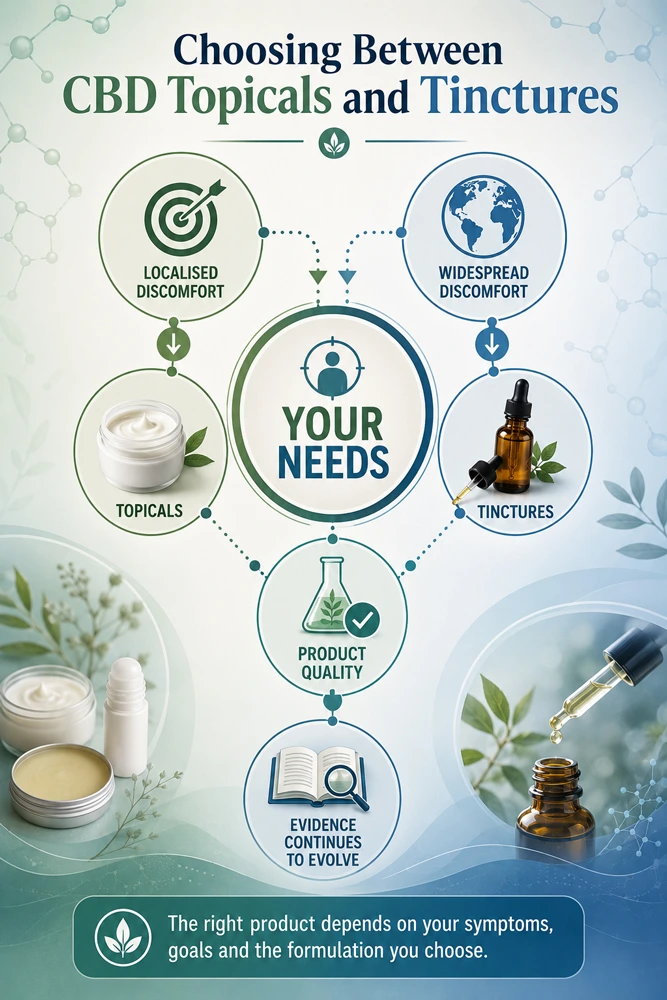
Cannabis topicals and tinctures are designed for different purposes rather than competing directly. Topicals may be better suited for localised joint or muscle discomfort because they are applied directly to the affected area, whereas tinctures may be more appropriate for widespread discomfort because they provide systemic exposure. Current evidence is promising but remains heterogeneous, meaning no single product format is universally superior.
Topicals vs Tinctures at a Glance
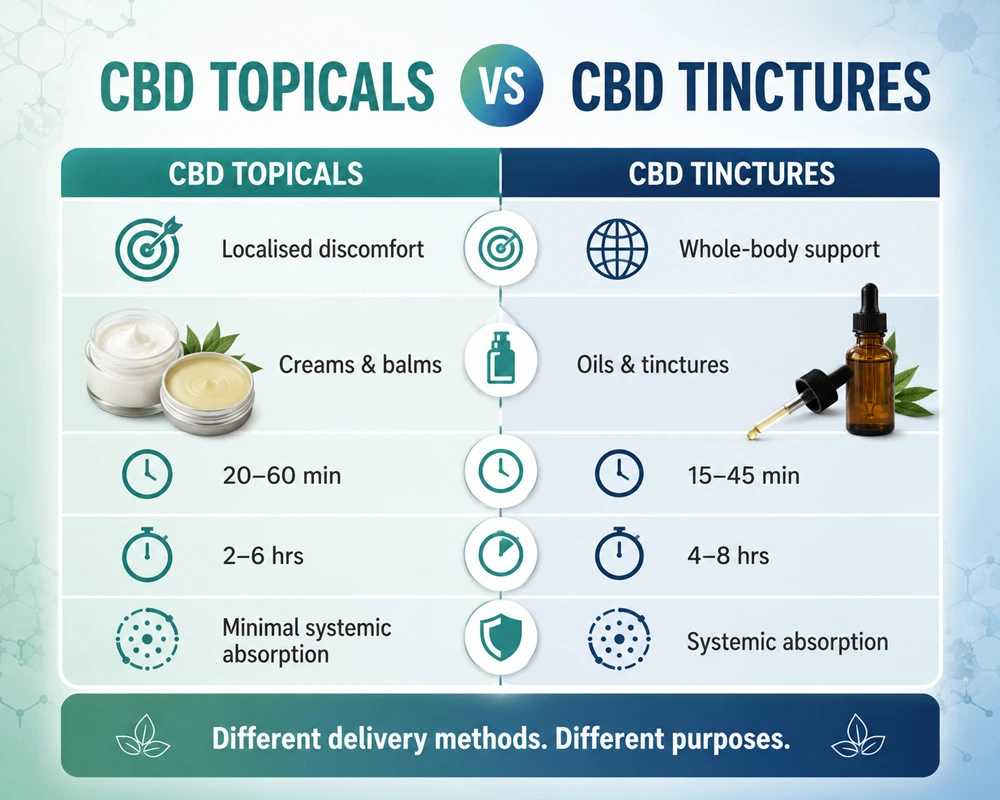
| Feature | CBD Topicals | CBD Tinctures |
|---|---|---|
| Best suited for | Localised discomfort | Widespread discomfort |
| Where they work | Skin and nearby tissues | Throughout the body |
| Typical onset | 20–60 minutes | 15–45 minutes |
| Typical duration | 2–6 hours | 4–8 hours |
| Systemic absorption | Minimal | Yes |
| Typical product types | Creams, balms, gels, roll-ons | Oils, tinctures, sprays |
What Are Cannabis Topicals?
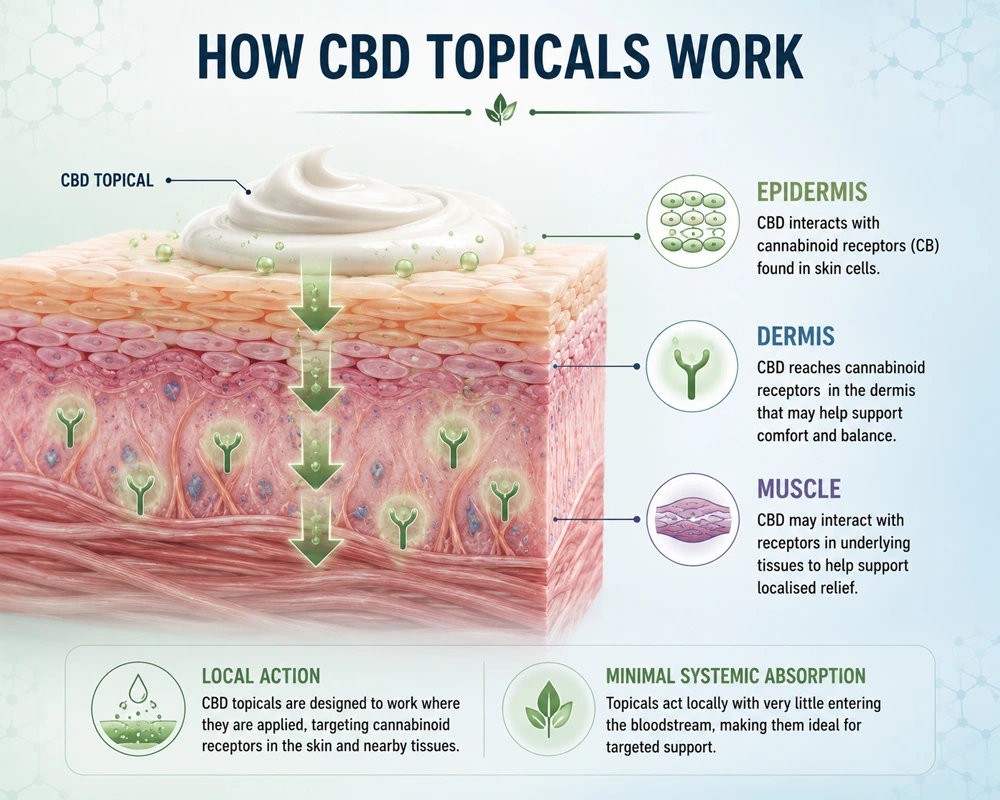
Cannabis topicals are products designed to be applied directly to the skin. Common examples include creams, balms, lotions, gels, and roll-ons.
Rather than circulating throughout the body, these products are intended to act primarily where they are applied. They interact with cannabinoid receptors found within the skin and surrounding tissues while producing very little systemic absorption under normal circumstances.
This makes topicals an appealing option for people looking to target a specific area, such as a sore shoulder, stiff knee or aching lower back, without exposing the rest of the body to significant amounts of cannabinoids.
Product formulation plays an important role. Factors such as carrier oils, moisturising ingredients and penetration enhancers may influence how effectively cannabinoids interact with the skin. Although laboratory studies have improved our understanding of skin absorption, researchers continue to investigate how these findings translate into real-world clinical outcomes.
What Are Cannabis Tinctures?
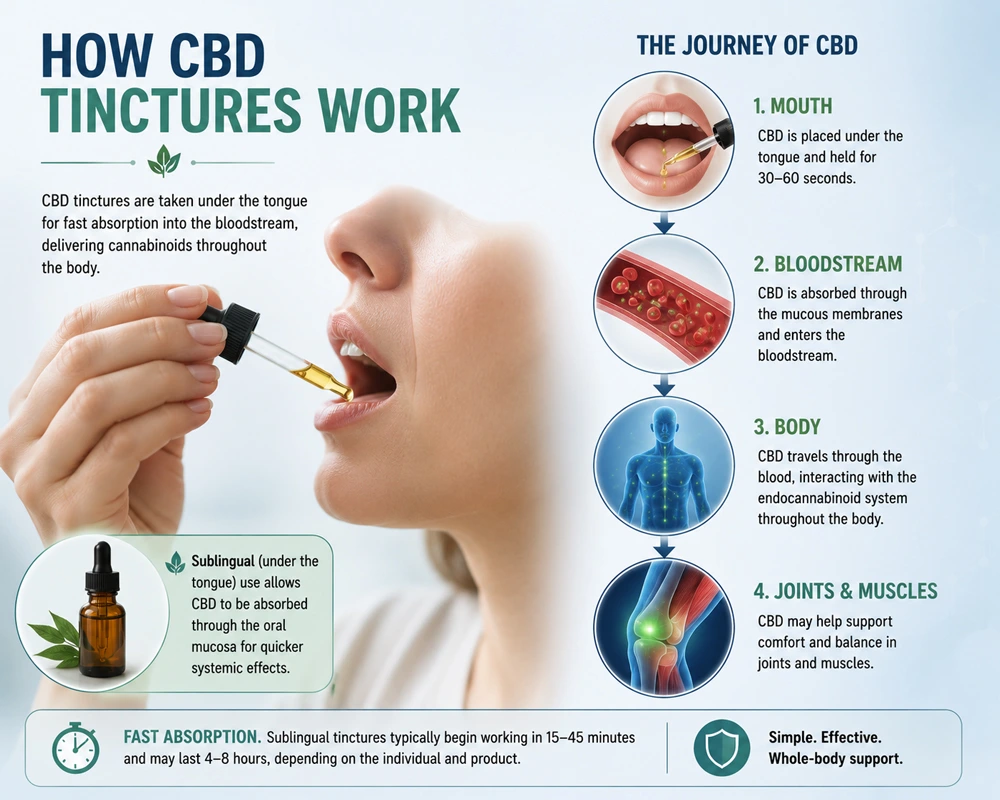
Cannabis tinctures are liquid cannabinoid extracts taken beneath the tongue using a dropper.
When held under the tongue for around 30 to 60 seconds before swallowing, cannabinoids are absorbed through the oral mucosa into the bloodstream. This allows them to bypass much of the digestive process and generally results in a faster onset than traditional edible products.
Because tinctures enter systemic circulation, they distribute cannabinoids throughout the body rather than concentrating them in one location. This whole-body exposure may make tinctures more suitable for people experiencing discomfort in multiple joints or muscle groups.
Tinctures are available in several formulations, including CBD isolate, broad-spectrum and full-spectrum products.
What Does the Research Say?
One of the biggest misconceptions about cannabis-derived products is that there is a simple answer to the question: Which works better?
The reality is more nuanced. Research into cannabinoids has grown rapidly over the past decade, but studies vary considerably in the products tested, the doses used, the medical conditions investigated, and the way outcomes are measured. As a result, evidence for chronic musculoskeletal pain remains heterogeneous, meaning different studies often reach different conclusions.
Rather than asking which format is universally better, it is more helpful to ask which format may be better suited to a particular type of discomfort.
Evidence for Topicals
Topical cannabinoid products currently have some of the most direct evidence for localised joint and muscle discomfort.
One double-blind, randomised controlled trial investigating topical CBD for thumb basal joint arthritis reported significant improvements in pain and disability without serious adverse effects. Another small clinical study found that topical CBD reduced pain, itching and cold sensations in people living with peripheral neuropathy.
These findings suggest that well-formulated topical products may provide targeted benefits when discomfort is confined to a specific area.
However, the evidence is far from uniform.
A Phase II clinical trial evaluating a transdermal CBD gel for knee osteoarthritis did not demonstrate significant improvement compared with placebo. Researchers believe differences in formulation, dosage, skin penetration and study design may explain why results vary between trials.
This highlights an important point for consumers: not all topical products are the same. Two creams containing the same amount of CBD may perform differently depending on their ingredients, manufacturing methods and overall formulation.
Evidence for Tinctures
Tinctures work differently because cannabinoids enter the bloodstream rather than remaining primarily at the site of application.
This whole-body exposure has made tinctures an area of interest for researchers studying chronic pain conditions affecting multiple joints or larger regions of the body.
A 2024 systematic review concluded that there is growing clinical and preclinical evidence suggesting CBD may help support pain management through several biological mechanisms. Researchers noted potential interactions with pathways involved in pain perception, inflammation and nervous system signalling, including TRPV1, 5-HT1A and CB1 receptors.
Because sublingual tinctures are absorbed relatively quickly, typically within 15 to 45 minutes, they may provide a practical option for people seeking a systemic approach rather than targeting one specific area.
Nevertheless, the available evidence still has limitations. Many studies involve relatively small numbers of participants, use different cannabinoid formulations, or investigate products that differ substantially from those available commercially.
Why Do Studies Sometimes Disagree?
It is common to see one headline claiming CBD works for pain while another reports little or no benefit.
This does not necessarily mean the research is contradictory. Instead, many studies are evaluating very different products under very different conditions.
Several factors can influence outcomes, including:
- CBD dose
- Presence or absence of THC
- Full-spectrum versus CBD isolate formulations
- Product quality and manufacturing standards
- Length of treatment
- The type of pain being studied
- Individual differences between participants
For example, a person with inflammatory arthritis may respond differently from someone with neuropathic pain or exercise-related muscle soreness. Similarly, a full-spectrum extract containing multiple cannabinoids and naturally occurring terpenes may behave differently from a purified CBD isolate.
Many clinical studies also investigate pharmaceutical-grade formulations that are not identical to products sold through retail outlets. This makes it difficult to apply research findings directly to every commercially available product.
For these reasons, healthcare professionals increasingly emphasise looking at the overall body of evidence rather than relying on a single study.
Which Format May Be Better Suited to Your Needs?
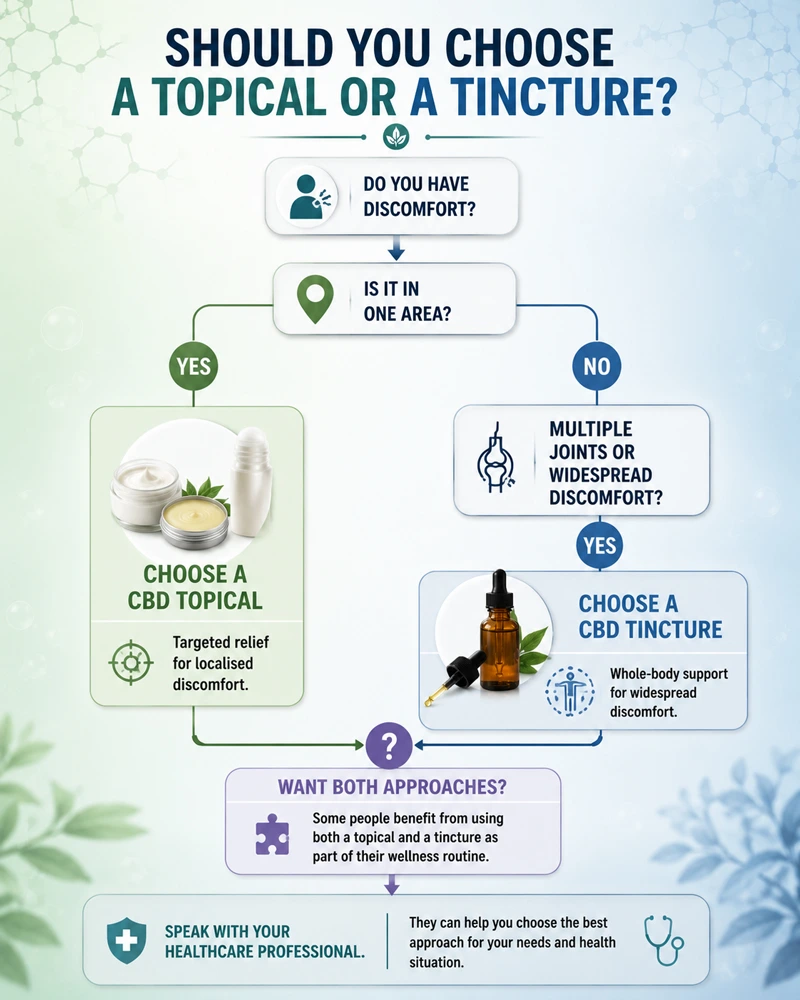
Although neither format is universally superior, current evidence allows some practical conclusions.
A CBD topical may be better suited if your discomfort is confined to one area, such as:
- An arthritic knee
- A stiff shoulder
- A sore lower back
- A strained muscle
- A specific joint following exercise
Topicals provide targeted application and generally produce minimal systemic exposure, making them an attractive option for people looking to focus on one area of the body.
A CBD tincture may be more appropriate if your discomfort:
- Affects multiple joints
- Is widespread rather than localised
- Occurs alongside sleep disturbances
- Requires flexible dose adjustment
- Benefits from a whole-body approach
Because tinctures circulate throughout the body, they may offer advantages when symptoms are not limited to a single location.
Some people living with chronic pain choose to use both approaches. For example, using a tincture as part of an overall wellness routine while applying a topical during temporary flare-ups.
It is important to note, however, that this "layering" strategy is based primarily on clinical experience and patient reports. There is currently limited high-quality clinical trial evidence specifically evaluating the combined use of topicals and tinctures, so further research is still needed.
What to Look for When Buying
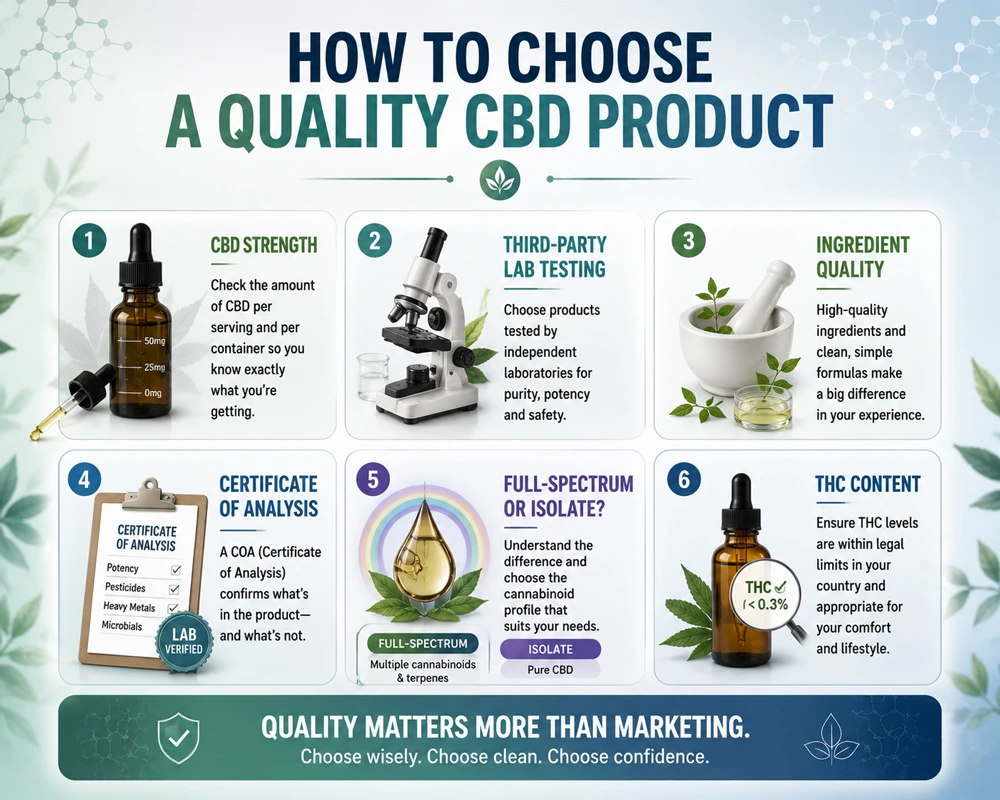
Choosing between a topical and a tincture is only part of the decision. Product quality, formulation, and cannabinoid profile can all influence your experience. While no product can guarantee a particular outcome, there are several features worth considering before making a purchase.
CBD Strength
CBD products are available in a wide range of strengths. A higher concentration does not automatically mean a better product, but it does affect how much you need to use. Always compare the total amount of CBD in the product, rather than relying solely on the size of the container.
Third-Party Laboratory Testing
One of the most important indicators of quality is independent laboratory testing. Reputable manufacturers provide a Certificate of Analysis (COA) from an accredited third-party laboratory, confirming cannabinoid content and screening for contaminants such as pesticides, heavy metals and residual solvents.
Ingredient Quality
The ingredients surrounding the cannabinoids matter too. High-quality carrier oils, moisturisers and botanical extracts can improve the user experience and, in some cases, influence how well a product performs. If you have allergies or sensitive skin, always check the full ingredient list before purchasing.
THC Content
Some products contain only CBD, while others are broad-spectrum or full-spectrum formulations that include additional cannabinoids and naturally occurring terpenes. Full-spectrum CBD products may also contain small amounts of THC.
Fragrance-Sensitive Skin
Many topical products include essential oils or fragrances to improve scent or create warming and cooling sensations. If you have sensitive skin or are prone to irritation, choosing a fragrance-free formulation may be the better option.
Common Product Formats
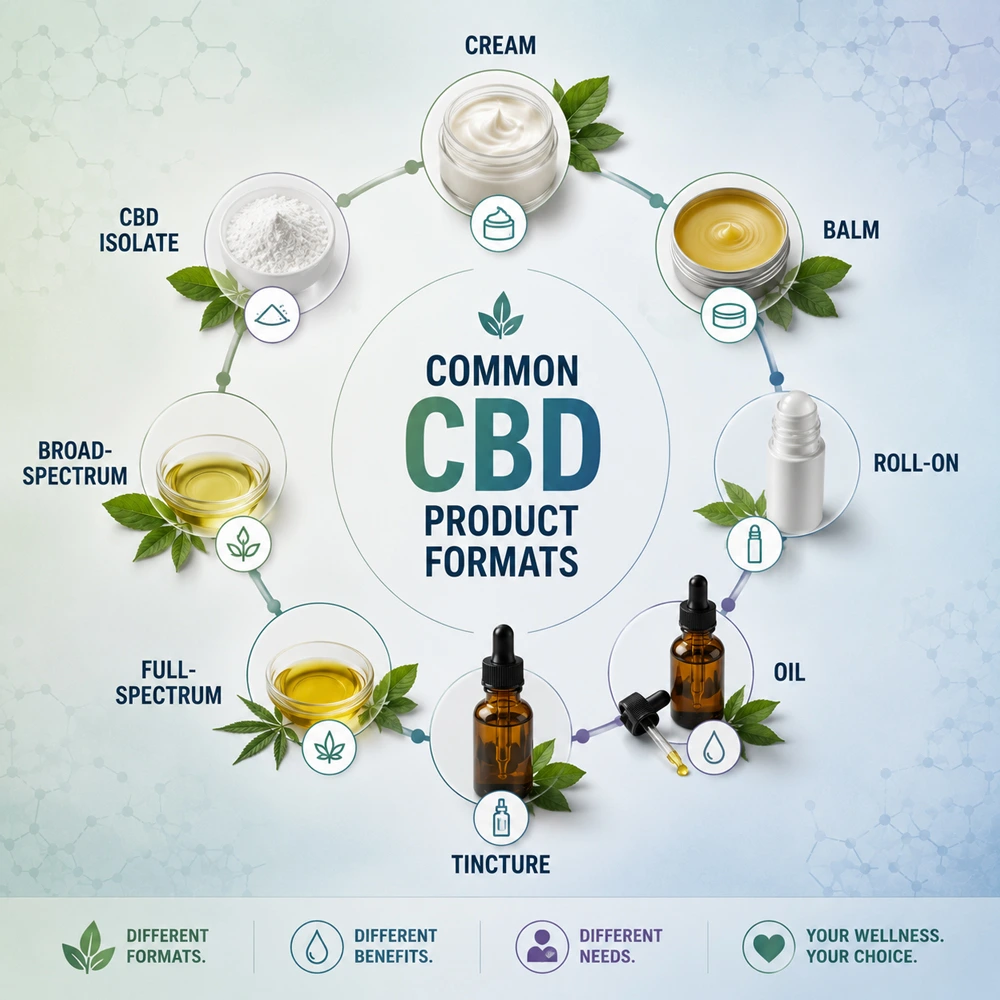
Cannabis-derived wellness products are available in several delivery formats, allowing consumers to choose the option that best suits their lifestyle and preferences.
Topicals
Common topical products include:
- CBD creams
- CBD balms
- Massage lotions
- Cooling or warming gels
- Roll-ons
- Body salves
These products are intended for direct application to specific areas of the body.
Tinctures
Common tincture products include:
- CBD oils
- CBD tinctures
- Full-spectrum tinctures
- Broad-spectrum tinctures
- CBD isolate oils
- Flavoured tinctures
Tinctures provide flexible dosing and can easily be incorporated into a daily wellness routine.
Frequently Asked Questions
Are CBD creams better than CBD oils?
Neither is universally better. CBD creams may be better suited for localised discomfort because they are applied directly to the affected area, whereas CBD oils and tinctures may be more appropriate for widespread symptoms due to their systemic absorption.
Do CBD creams enter the bloodstream?
Most traditional CBD creams are designed to act locally and produce minimal systemic absorption. Transdermal products are different because they are specifically formulated to deliver cannabinoids through the skin into the bloodstream.
Which works faster: a topical or a tincture?
Sublingual tinctures generally begin working within 15 to 45 minutes because cannabinoids are absorbed through the tissues beneath the tongue. Topicals typically begin working within 20 to 60 minutes, although onset varies depending on the formulation and where they are applied.
Can I use a topical and a tincture together?
Some healthcare professionals and patients report using both formats as part of an overall wellness strategy. However, this approach is based primarily on clinical experience and anecdotal reports rather than large clinical trials, so more research is needed.
What is the difference between full-spectrum and CBD isolate?
CBD isolate contains only cannabidiol, while full-spectrum products contain CBD alongside other naturally occurring cannabinoids and terpenes. These different formulations may influence how individuals respond, although research into these differences continues to evolve.
How do I know if a CBD product is good quality?
Look for products that provide third-party laboratory testing, clearly state their CBD concentration, list all ingredients, disclose cannabinoid content, and are manufactured by reputable companies that prioritise quality and transparency.
Key Takeaways
- Cannabis topicals and tinctures are designed for different purposes.
- Topicals may be better suited for localised joint and muscle discomfort.
- Tinctures may be more appropriate for widespread symptoms because they provide systemic exposure.
- Product formulation, including CBD concentration, cannabinoid profile and ingredient quality, can significantly influence outcomes.
- Current research is promising, but evidence remains heterogeneous and continues to evolve.
- Choosing products that provide independent laboratory testing can help improve confidence in quality and cannabinoid content.
- Always consult a healthcare professional before using cannabinoid products, particularly if you take prescription medication or have an underlying medical condition.
The Bottom Line
When comparing cannabis topicals and tinctures, there is no single "best" option. Instead, each delivery method offers different advantages depending on your individual needs.
Current evidence suggests that topicals may be better suited for localised joint and muscle discomfort, while tinctures may be more appropriate for more widespread symptoms because they provide whole-body exposure. Factors such as CBD strength, formulation, cannabinoid profile, product quality and your own response all play an important role.
As research into cannabinoids continues to expand, consumers are gaining access to better information and higher-quality products than ever before. The key is to choose laboratory-tested products, understand the different formulations available and maintain realistic expectations about what current evidence supports.
Ready to learn more? Compare CBD topicals, creams, balms, roll-ons, oils and tinctures on Cannamart to explore different product formats, strengths and cannabinoid profiles. Understanding how these products differ can help you make a more informed decision based on your individual wellness goals. Explore CBD Product Formats
References
- Cásedas G, de Yarza-Sancho M, López V. Cannabidiol (CBD): A Systematic Review of Clinical and Preclinical Evidence in the Treatment of Pain. Pharmaceuticals. 2024.
- Xu DH, Cullen BD, Tang M, Fang Y. The effectiveness of topical cannabidiol oil in symptomatic relief of peripheral neuropathy of the lower extremities. Current Pharmaceutical Biotechnology. 2020.
- Hunter JG, et al. A Randomized Controlled Trial of Topical Cannabidiol for the Treatment of Thumb Basal Joint Arthritis. Journal of Hand Surgery. 2022.
- Hammell DC, et al. Transdermal Cannabidiol Reduces Inflammation and Pain-Related Behaviours in a Rat Model of Arthritis. European Journal of Pain. 2016.
- Millar SA, Stone NL, Yates AS, O'Sullivan SE. A Systematic Review on the Pharmacokinetics of Cannabidiol in Humans. Frontiers in Pharmacology. 2018.
- Paudel KS, Hammell DC, Agu RU, Valiveti S, Stinchcomb AL. Cannabinoid Delivery Through the Skin. Advanced Drug Delivery Reviews. 2010.
- National Center for Complementary and Integrative Health (NCCIH). Cannabis (Marijuana) and Cannabinoids: What You Need To Know.
Disclaimer: This blog supports responsible cannabis use. The information contained in this article is for educational and informational purposes only and is not intended as health or medical advice. Always consult a physician or other qualified health provider regarding any questions you may have about a medical condition or health objectives.
Our latest content
Check out what's new in our company !