Walk into almost any wellness store today, and you'll probably find CBN gummies promising deep sleep, restful nights, and calmer mornings. Some products even hint at pain relief, positioning CBN as the next breakthrough cannabinoid.
But does the science support these claims?
Like many areas of cannabis research, the answer is more nuanced than the marketing suggests. While early research is encouraging, particularly for sleep, CBN is far from a miracle solution. Understanding where it may help, and where evidence is still developing, can help you make more informed decisions.
First Things First: What Is CBN?
Cannabinol (CBN) is one of the many naturally occurring cannabinoids found in cannabis.
Unlike CBD, CBN isn't produced in large amounts by the plant. Instead, it forms naturally as THC ages and oxidises over time. Because of this, older cannabis typically contains higher levels of CBN.
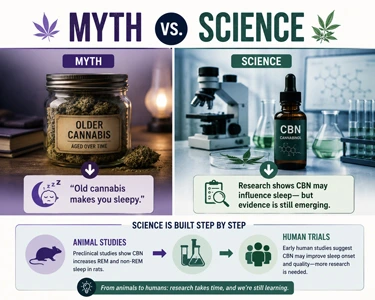
For years, people believed aged cannabis caused sleepiness because of its CBN content. It was a widely accepted explanation, but surprisingly, one that had never been properly tested.³
The Sleep Story: Where CBN Shows Promise
That changed when researchers from the University of Sydney's Lambert Initiative investigated CBN using objective sleep measurements.³
Their preclinical study found that CBN increased both REM and non-REM sleep in rats, providing the first measurable evidence that the cannabinoid may influence sleep architecture rather than relying purely on anecdotal reports. Importantly, this was an animal study, meaning the findings cannot automatically be applied to humans, but it provided an important starting point for further research.³
More recently, human studies have begun adding to the picture.
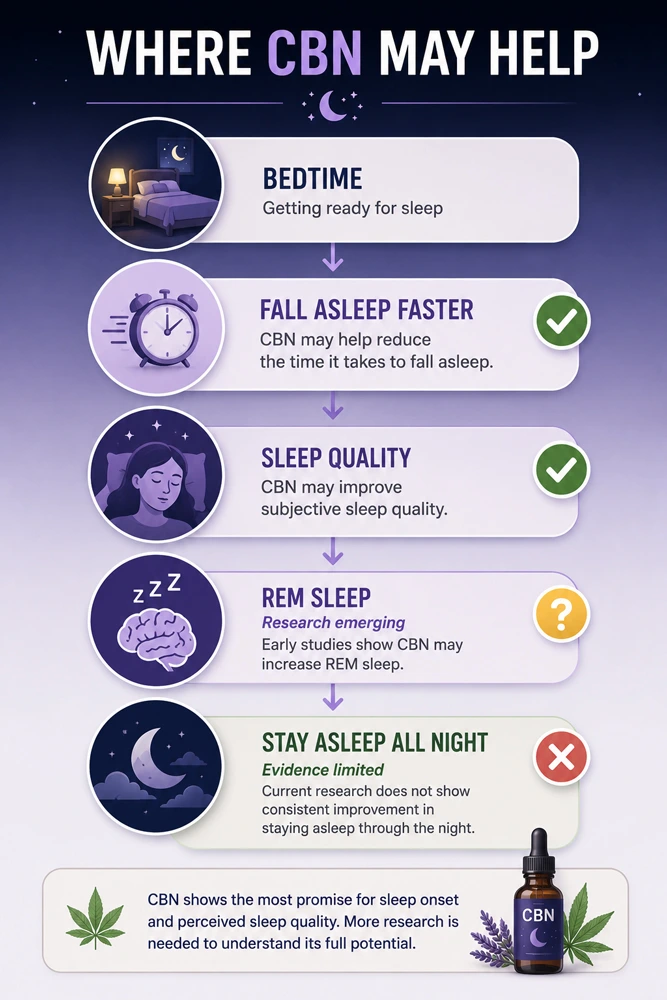
A randomised, double-blind, placebo-controlled clinical trial involving adults with physician-diagnosed insomnia found that CBN improved several measures of sleep quality and helped participants fall asleep more quickly. However, it did not significantly improve the study's primary outcome or reduce the amount of time people remained awake during the night. The researchers concluded that the findings justify larger and longer-term clinical trials rather than definitive conclusions.¹
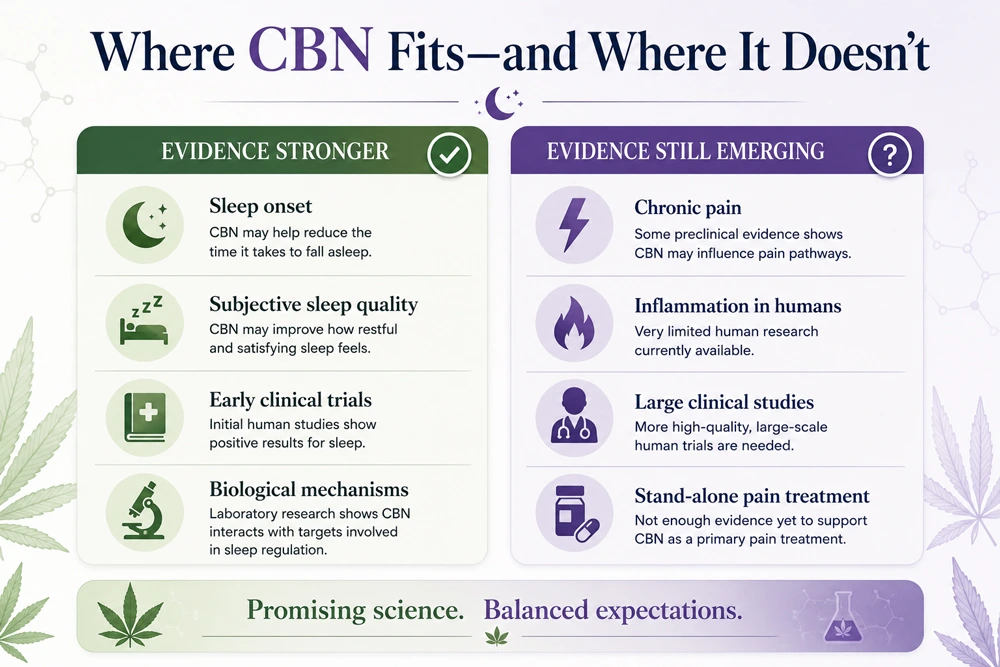
Taken together, the evidence suggests that CBN may be particularly helpful for:
- Falling asleep more easily
- Improving perceived sleep quality
- Supporting healthy sleep patterns
What it doesn't yet show is that CBN consistently keeps people asleep throughout the night or treats chronic insomnia.¹
Explore Our Sleep Support Collection
A good night's sleep looks different for everyone. Whether you're exploring CBD oils, CBN products, herbal blends or other cannabis wellness options, Cannamart offers a carefully curated range to help support your evening wellness routine.
Browse our online shop and discover products designed to help you unwind, relax and support a more restful night's sleep.
Looking at the Bigger Picture
Individual studies are useful, but systematic reviews give us an even broader understanding.
A 2025 meta-analysis published in Sleep Medicine Reviews analysed six randomised controlled trials involving more than 1,000 participants. Overall, cannabinoid therapies improved subjective sleep quality.²
One particularly interesting finding was that the improvements appeared to be driven mainly by formulations containing cannabinoids other than CBD alone. CBD-only products did not demonstrate statistically significant improvements in sleep quality.²
However, researchers also highlighted an important limitation: the studies differed considerably in their design, cannabinoid formulations and participant populations. In scientific terms, there was high heterogeneity, meaning larger, well-designed studies are still needed before firm conclusions can be drawn.²
Additional evidence comes from a large placebo-controlled trial evaluating a proprietary CBN formulation, where all CBN dose groups demonstrated significant improvements in sleep quality compared with placebo, with results broadly comparable to a standard dose of melatonin. Even so, the authors noted that rigorous, large-scale research on CBN remains limited.⁴
What About Pain?
Pain is where enthusiasm currently runs ahead of the evidence.
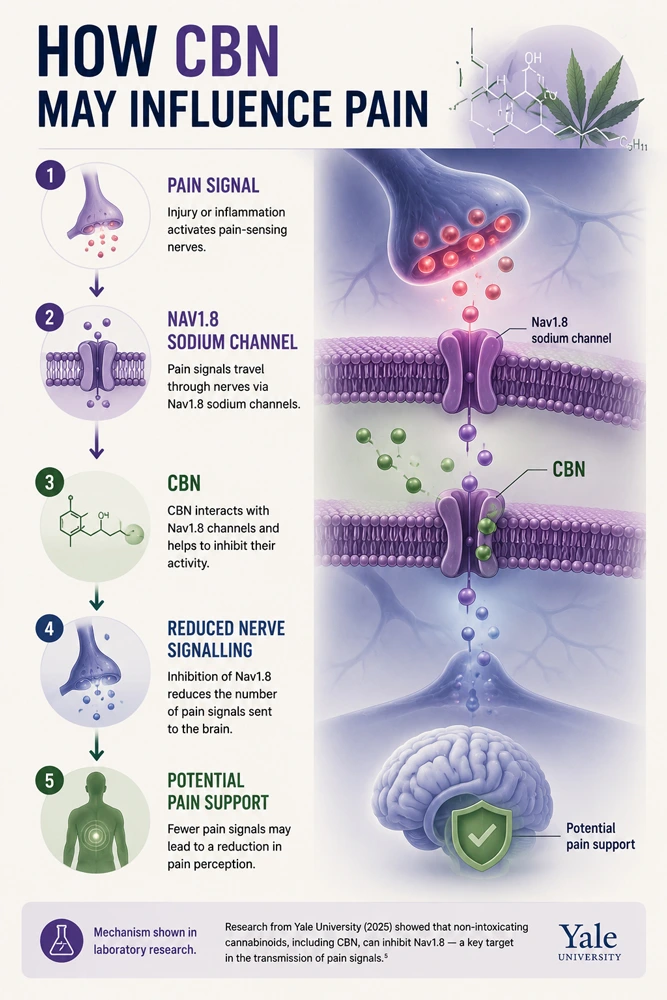
Laboratory research suggests there are plausible biological reasons why CBN could play a role in pain management.
Researchers from Yale University demonstrated that several non-intoxicating cannabinoids, including CBD, CBG and CBN, can inhibit Nav1.8, a sodium channel involved in transmitting pain signals through sensory nerves. This offers an exciting potential mechanism for future therapies.⁵
Interestingly, within that study, CBG showed the strongest effect, while CBN appeared to play more of a supporting role.⁵
Other laboratory and animal studies suggest CBN may also possess anti-inflammatory and antioxidant properties that could contribute to pain modulation.⁶
However, these findings should be interpreted carefully.
To date, there are very few human clinical trials evaluating CBN as a standalone treatment for pain. Reviews of cannabinoids in pain management have generally found mixed results, and current evidence does not show that cannabinoids consistently reduce opioid requirements in acute pain settings.⁷
At present, the science suggests CBN has biological potential, but not enough clinical evidence to recommend it as a primary pain treatment.⁵⁻⁷
Explore Our Pain Support Collection
Every person's experience with pain is unique, and so is their wellness journey. Whether you're looking for CBD oils, topicals, capsules or other cannabis wellness products, Cannamart offers a carefully curated range to support your individual needs.
Browse our online shop and discover products that may help you move, recover and feel your best.
Where CBN Doesn't Fit, Yet
CBN isn't snake oil, nor is it the proven sleep or pain solution that some product labels imply.
Current evidence suggests:
- Sleep research is promising but still emerging.¹²⁸
- Human studies remain relatively small.¹⁴⁸
- Larger clinical trials are needed before firm conclusions can be drawn.¹²⁴⁸
- Direct evidence for pain relief in humans is currently limited.⁵⁻⁷
That's not unusual for cannabinoid research. In fact, recent systematic reviews conclude that the current evidence base has not yet caught up with the widespread use of cannabinoid products for sleep disorders. Science progresses by building evidence across multiple well-designed clinical trials rather than relying on early promising findings alone.⁸
A Quick Word on Safety
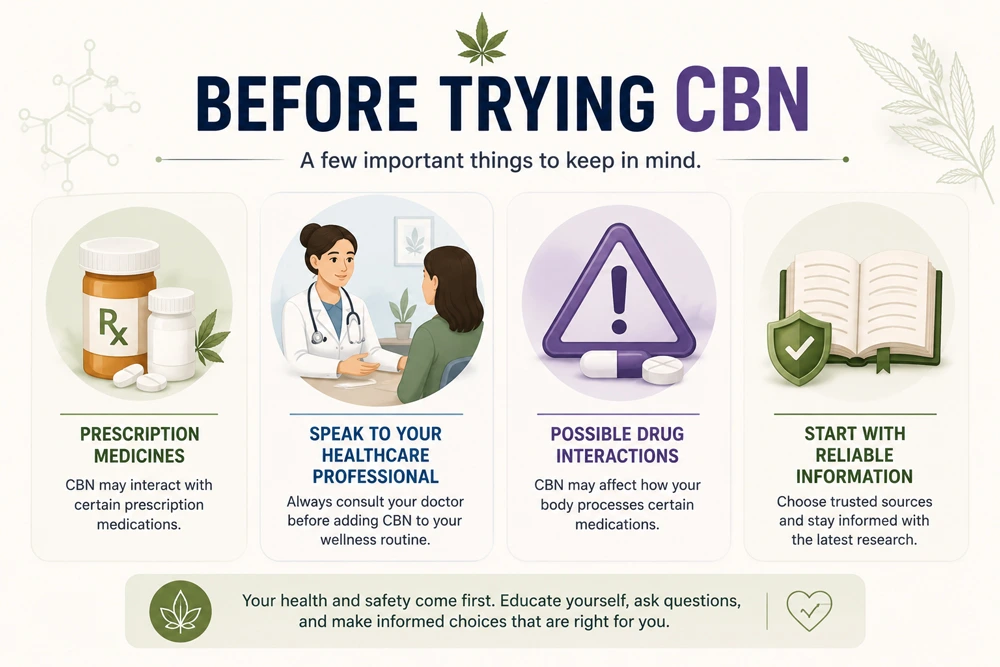
Like many cannabinoids, CBN is metabolised through the cytochrome P450 enzyme system, the same pathway used by many prescription medicines.⁶
This means CBN may interact with certain medications, including some antidepressants, blood thinners, anticonvulsants and other commonly prescribed treatments.⁶
If you're considering adding CBN to your wellness routine, especially if you take prescription medication or have an existing medical condition, it's worth speaking to your healthcare professional first.
The Bottom Line
CBN is an exciting cannabinoid, but it's still early days.
The strongest evidence currently points towards supporting sleep onset and improving perceived sleep quality, while research into pain relief remains largely preclinical and larger human trials are still needed.¹⁻⁸
As researchers continue exploring the endocannabinoid system, CBN may eventually find an important place alongside other cannabinoids such as CBD, CBG and THC. For now, however, it's best viewed as one piece of a much bigger puzzle rather than a standalone solution.
At Cannamart, we believe informed choices start with balanced, evidence-based education. As new research emerges, we'll continue bringing you the latest science, without the hype.
Frequently Asked Questions (AEO)
Is CBN better than CBD for sleep?
Current research suggests that CBN may have greater potential for improving sleep onset than CBD alone, although larger clinical studies are still needed.
Can CBN help with chronic pain?
There is currently insufficient human evidence to conclude that CBN effectively treats chronic pain. Most supportive evidence comes from laboratory and animal studies.
Does CBN make you high?
No. CBN is considered mildly psychoactive at most and is far less intoxicating than THC.
Can I take CBN every night?
While many people use CBN regularly, long-term safety data remain limited. If you take prescription medication or have an underlying medical condition, speak to your healthcare professional before using CBN.
Does CBN interact with medications?
Potentially. CBN is metabolised through the cytochrome P450 enzyme system and may interact with certain prescription medicines.
Curious About Cannabinoids or Cannabis Products?
Explore Cannamart's growing library of educational articles to better understand CBD, CBG, CBN, THC and the Endocannabinoid System, so you can make informed wellness decisions backed by balanced, science-based information. Alternatively chat to Budley, our friendly AI bot for advice and product information.
References
- Suraev A, Marshall NS, Grunstein RR, et al. Cannabinol (CBN) improves sleep onset and subjective sleep quality in adults with insomnia: a randomised, double-blind, placebo-controlled crossover trial. Journal of Sleep Research. 2026.
- Pattnaik F, Murnion B, Suraev A, et al. Cannabinoids and subjective sleep quality: A systematic review and meta-analysis of randomised controlled trials. Sleep Medicine Reviews. 2025.
- Arnold JC, McGregor IS, Suraev A, et al. Cannabinol increases sleep using objective sleep measures in rats. Neuropsychopharmacology. 2024.
- Corroon J, Sexton M, Duffy S, et al. Effect of cannabinol (CBN) on sleep quality: Results from a randomised, placebo-controlled clinical trial comparing multiple doses of CBN with melatonin and placebo. Frontiers in Pharmacology. 2024.
- Rizzi S, Yao BB, Abooj M, et al. Nav1.8 is an analgesic target for nonpsychotomimetic phytocannabinoids. Proceedings of the National Academy of Sciences of the United States of America. 2025.
- Moreno-Sanz G, Hernández-Torres G, García C, et al. Cannabinol (CBN): Pharmacology, therapeutic potential and metabolism. Industrial Crops and Products. 2024.
- Nielsen S, Sabioni P, Trigo JM, et al. Opioid-sparing effect of cannabinoids for analgesia: An updated systematic review and meta-analysis of preclinical and clinical studies. Neuropsychopharmacology. 2022.
- Choi Y, DiNicolantonio JJ, O'Keefe JH, et al. Cannabis and sleep disorders: Not ready for prime time? A systematic review of human studies. Journal of Cachexia, Sarcopenia and Muscle. 2022.
Disclaimer: This blog supports responsible cannabis use. The information contained in this article is for educational and informational purposes only and is not intended as health or medical advice. Always consult a physician or other qualified health provider regarding any questions you may have about a medical condition or health objectives.
Our latest content
Check out what's new in our company !