Few things are as irritating as waking up, wandering into the bathroom and discovering that a spot has apparently moved onto your chin overnight. Uninvited, and rather suspiciously, it has arrived at exactly the same time as your period, a stressful week, or several nights of questionable sleep.
Welcome to the wonderfully frustrating world of hormonal acne.
If you're already curious about cannabis and wellness, you may also have wondered:
Could CBD skincare have a place in my routine?
It's a good question, and an increasingly relevant one.
CBD creams, facial oils, serums, balms and other cannabis-inspired skincare products have created an entirely new category for curious consumers to explore. And while CBD isn't an established treatment for hormonal acne, research into cannabinoids and skin biology gives us some genuinely interesting reasons to keep paying attention.
So rather than asking whether CBD is a miracle acne cure, let's ask a more useful question:
Where could CBD skincare fit, and what should you look for when choosing a product?
First Things First: What Is Hormonal Acne?
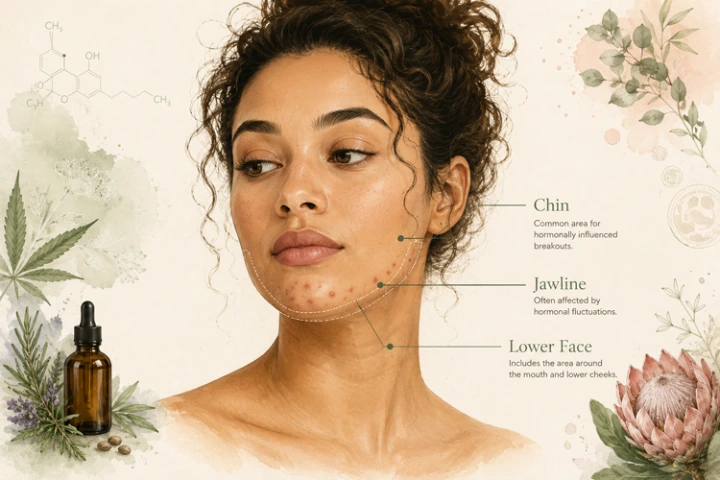
Hormonal acne is a common term for acne that appears to be strongly influenced by hormonal activity or fluctuations.
It frequently appears around the chin, jawline and lower face and may become more noticeable around menstruation, pregnancy, perimenopause or other periods of hormonal change. Androgens such as testosterone and dihydrotestosterone (DHT) can influence the sebaceous glands responsible for producing sebum.¹⁻³
But acne isn't simply an “oily skin” problem.
Sebum production, activity within the hair follicle, Cutibacterium acnes, hormonal signalling and inflammatory responses can all contribute. That last part, inflammation, is particularly interesting when we start looking at cannabis research.
Acne Isn't Simply an “Oily Skin” Problem
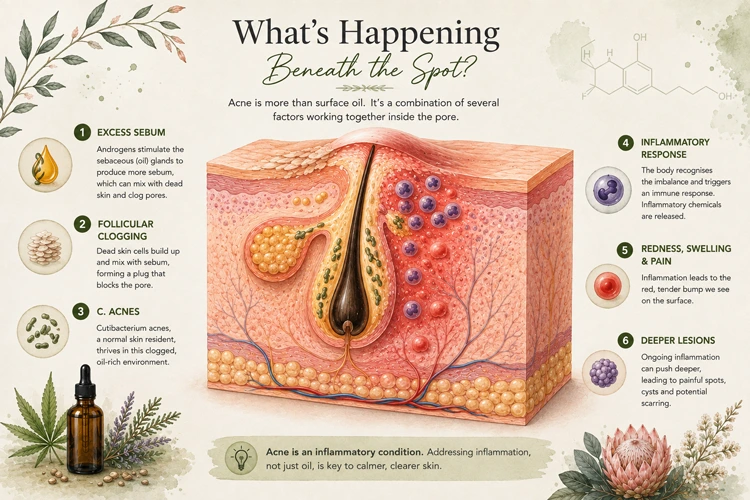
For a long time, acne was explained rather neatly: Blocked pore → bacteria → inflammation.
Simple. Except skin isn't particularly interested in being simple. We now understand that inflammatory processes can begin very early in acne development, sometimes before that angry red spot has even announced itself in the mirror. That changes the way we think about acne. Because if inflammation is part of the process from early on, the answer isn't necessarily to scrub harder, cleanse more aggressively or try to remove every molecule of oil from your face.
Your face is not a dirty frying pan. Hormonal signalling, sebum production, activity inside the follicle, the skin microbiome and inflammatory responses can all be involved. And this is where cannabis research becomes interesting. Not because cannabis has suddenly become an acne cure. It hasn't. But because scientists are beginning to understand more about how cannabinoid signalling interacts with the skin.
So... What Does CBD Actually Have to Do With Skin?
Your skin contains components of the endocannabinoid system (ECS), a signalling network found throughout the body.
Researchers have identified cannabinoid receptors and other ECS components in different structures and cells within the skin. This has prompted scientists to investigate how cannabinoids such as CBD might interact with processes including sebaceous gland activity and inflammatory signalling.
Much of this research remains laboratory, preclinical or early-stage research, so there is still plenty to learn, but that's what makes this area exciting.
CBD skincare sits at the intersection of an established skincare industry and a rapidly developing field of cannabinoid research. For consumers interested in cannabis wellness, it offers another way to explore cannabinoids through topical products designed specifically for the skin.
The important distinction is that a promising ingredient and a clinically established acne treatment aren't necessarily the same thing, and they don't need to be.
A skincare product can form part of someone's wider skincare or self-care routine without needing to promise that it will “cure hormonal acne”.
So, Can CBD Skincare Help?
At present, we don't have enough high-quality human clinical evidence to describe CBD as an established treatment for hormonal acne. What we do have is growing scientific interest in cannabinoids and skin biology.
CBD has been investigated for possible effects involving inflammatory signalling and sebaceous activity, among other areas. That makes it an interesting skincare ingredient and one worth following as research develops. For Cannamart shoppers, the practical question therefore isn't simply: “Does CBD cure acne?” A better question is: “Is this CBD skincare product suitable for what I want from my skincare routine?”
That small change in perspective makes shopping considerably easier.
Topicals, Oils, Gummies... Aren't They All CBD?
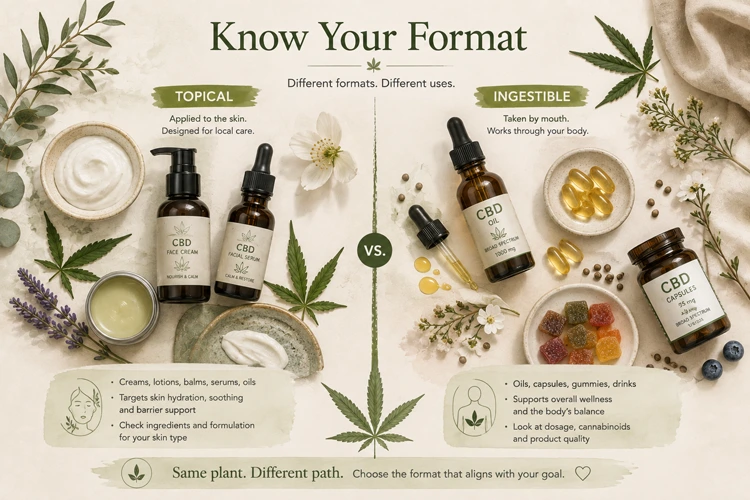
No, they are not, and to know this matters enormously, especially if you're exploring cannabis products because you're interested in skincare. You'll probably encounter products that fall into very different categories.
CBD and Cannabis Topicals
Topicals are products you apply directly to your skin.
You might come across:
facial oils; and
But here's the bit that's easy to forget when “CBD” is printed in enormous letters across the front of the packaging: CBD is only one ingredient.
The rest of the formulation matters too.
A gorgeous CBD facial oil might contain carrier oils, fragrances, botanical extracts, preservatives and other ingredients. Some might suit your skin beautifully, and others might not. Especially if your skin is already acne-prone, sensitive or irritated. So don't shop for the word CBD, but rather shop for the whole product.
What About CBD Oils, Capsules and Gummies?
These are a completely different conversation.
Oils, capsules, gummies and other ingestible products shouldn't suddenly become “acne products” simply because researchers are studying connections between cannabinoids, stress, inflammation or sleep.
This is where wellness logic can occasionally go on a little adventure of its own: Stress can affect acne.
CBD is being researched for stress. Therefore, CBD treats stress-related acne. No.
Those three statements do not magically become clinical evidence when we put them next to one another. If you're researching acne specifically, a topical CBD product and an ingestible CBD product are very different purchasing decisions. Neither should automatically be considered an acne treatment.
Before You Buy CBD Skincare, Turn the Bottle Around
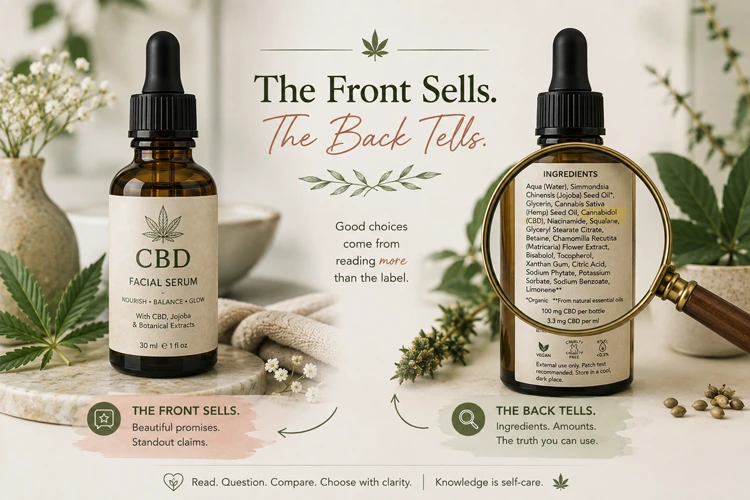
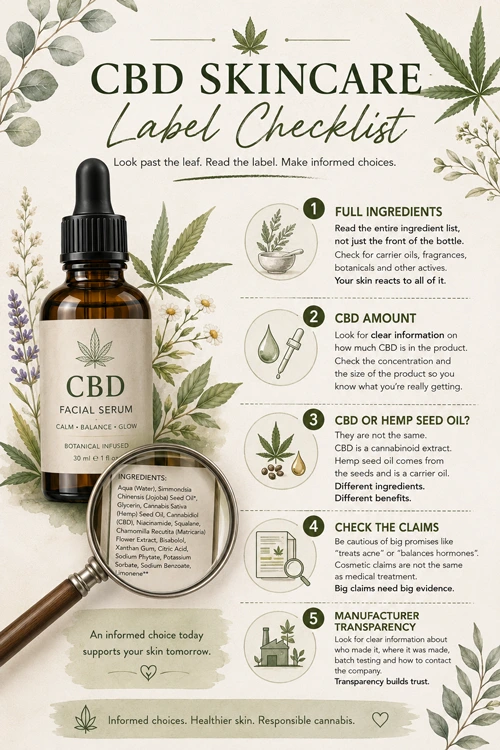
The front of a skincare bottle is where the marketing department lives. The back is usually where the useful information is hiding. So rather than asking only: “Does this contain CBD?” start asking: “What am I actually buying?”
1. Read the Whole Ingredient List
Your skin doesn't only experience the ingredient printed in the biggest font. Look at the full formulation. What carrier oils are being used? Are there fragrances? Botanical extracts? Other active ingredients? If your skin is acne-prone or sensitive, the whole formulation matters far more than the cannabis leaf on the box.
2. Find Out How Much CBD Is Actually There
This is a big one. Words such as “cannabis-infused”, “hemp”, “hemp extract” and “CBD” don't necessarily mean the same thing.
Look for clear information about:
which cannabinoid ingredient is included;
how much is present;
the size of the product; and
how the manufacturer describes its cannabinoid content.
If CBD is prominent on the front but suddenly becomes very shy when you start looking for actual numbers, that's worth noticing.
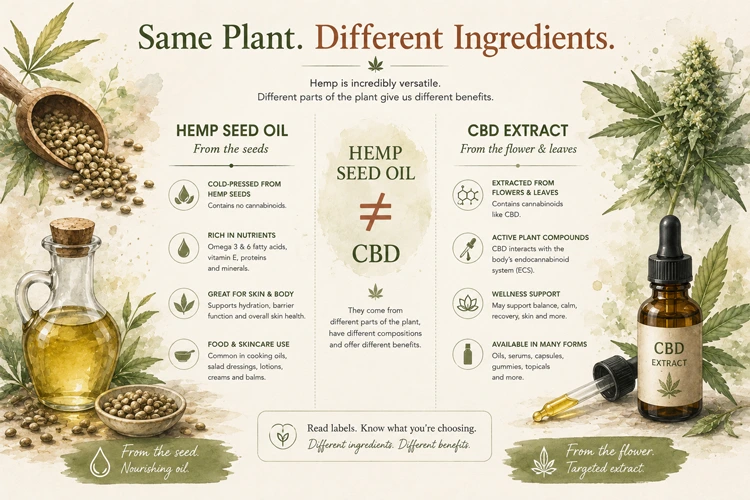
3. Hemp Seed Oil and CBD Are Not the Same Thing
This causes an enormous amount of confusion. Hemp seed oil is not the same thing as CBD oil. Hemp seed oil comes from hemp seeds and is widely used in cosmetics and skincare. CBD is a cannabinoid generally extracted from cannabinoid-rich parts of the cannabis plant and then added to a formulation. Hemp seed oil can be a perfectly legitimate skincare ingredient. CBD can be a perfectly legitimate product ingredient. They're simply not the same thing. Knowing that one little distinction already makes you a considerably harder person to mislead with clever packaging.
4. Pay Attention to the Promises
This is one of the easiest ways to assess a product. There is a big difference between saying a product: “moisturises the skin” and saying it: “treats hormonal acne”.
One is a cosmetic claim. The other wanders into medical territory. As a general rule, the bigger the promise, the more evidence you should expect to see behind it.
5. Choose Transparency Over Hype
You shouldn't need detective training to work out what you've bought.
A trustworthy product should make it reasonably easy to understand:
what's in it;
what it's intended for;
how you should use it;
who manufactured or supplied it;
what warnings apply; and
what cannabinoid information is relevant.
Mystery is wonderful in detective novels. Not so much when you're putting something on your face.
And Yes, Diet, Stress and Sleep Still Matter
We can't talk honestly about hormonal acne and pretend the rest of your life doesn't exist.
Research suggests that higher-glycaemic dietary patterns may influence acne through insulin and insulin-like growth factor 1 (IGF-1) signalling. Associations between dairy and acne have also been investigated, although individual responses vary.¹˒⁵
Stress and poor sleep may influence hormonal, immune and inflammatory processes too.⁴
But we don't want this to become another article that leaves you with 47 lifestyle changes and the vague feeling that your skin is misbehaving because you haven't meditated enough.
You are allowed to be human. Eat reasonably well. Sleep enough when you can. Find ways of dealing with stress that genuinely work for you. And please ignore the corner of the internet suggesting every breakout can be cured through kale, meditation and moral superiority.
Don't Forget the Skincare We Already Know Something About
Being curious about CBD skincare doesn't mean throwing established acne care out of the bathroom cabinet. Evidence-based acne ingredients can include salicylic acid, benzoyl peroxide and topical retinoids, depending on your skin and appropriate professional advice.
Gentle cleansing, moisturising and daily sunscreen still matter too. And if you decide to introduce a CBD or cannabis topical, introduce it sensibly. Don't change your cleanser, serum, moisturiser, retinoid, facial oil and entire personality on the same Tuesday.
If your skin reacts, you'll have absolutely no idea which product caused it. One change at a time. Your face will thank you.
Sometimes Your Skin Needs More Than a New Product
There is also a point where shopping needs to stop and professional help needs to start. CBD skincare should never delay appropriate medical care. Speak to a GP, dermatologist or appropriately qualified healthcare professional if your acne is:
deep or painful;
causing scars or persistent pigmentation;
suddenly becoming significantly worse;
affecting your confidence or wellbeing;
not improving despite appropriate over-the-counter care; or
accompanied by other symptoms that might suggest an underlying hormonal issue.
Acne is a genuine medical condition. Prescription and hormonal treatments exist for a reason. Choosing medical treatment doesn't mean you've somehow failed at natural wellness. Sometimes it simply means you're using the right tool for the job.
Hormonal Acne and CBD: The Questions We'd Ask Too
Can CBD skincare treat hormonal acne?
At the moment, there isn't enough high-quality clinical evidence to establish CBD skincare as a treatment for hormonal acne. Research into cannabinoids and skin biology is developing, and it's worth watching. But emerging research and established treatment aren't the same thing.
Is CBD anti-inflammatory for skin?
CBD has been investigated for its effects on inflammatory signalling in laboratory and preclinical research. That doesn't mean every CBD cosmetic has been clinically proven to reduce inflammation or treat an inflammatory skin condition. The finished product matters. The evidence matters. And the wording of the claim matters.
Is hemp seed oil the same as CBD?
No. Hemp seed oil is derived from hemp seeds and is commonly used as a cosmetic ingredient or carrier oil. CBD is a cannabinoid obtained from cannabinoid-containing parts of the cannabis plant. Same plant family. Different ingredients.
Should acne-prone skin avoid CBD facial oils?
Not necessarily. But don't look at the CBD in isolation. Look at the entire formulation, including carrier oils, fragrances and other ingredients, and consider whether those are appropriate for your particular skin.
Are CBD gummies or oils a treatment for hormonal acne?
There isn't enough evidence to recommend ingestible CBD products as a treatment for hormonal acne. Be especially cautious when marketing tries to turn several separate pieces of wellness research into one convenient treatment claim.
What should I compare when choosing CBD skincare?
Start with the basics: What's actually in it? How much CBD does it contain? What format is it? What is it supposed to do? Who made it? What claims are they making? And is there reasonable evidence behind those claims? In other words: look past the cannabis leaf.
The Takeaway: Your Skin Doesn't Need Another Miracle Promise
Hormonal acne is complicated. Hormones, sebum, follicular activity, Cutibacterium acnes, immune signalling and inflammation can all be part of the picture. Diet, stress and sleep may play supporting roles for some people too. And now cannabinoid science has added another interesting piece to the conversation.
Interesting is good. Curiosity is good. But curiosity doesn't require us to turn every promising piece of cannabis research into a miracle product.
If you're interested in CBD or cannabis skincare, learn about it start by reading the label, and turning the bottle around. Understand the format, and look at the ingredients. Compare the cannabinoid information. Question impressive promises. And know when you're looking at an interesting wellness product versus something with solid evidence as a medical treatment. Because informed cannabis shopping isn't about finding the bottle with the biggest cannabis leaf. It's about becoming the kind of consumer who knows what questions to ask.
References
Baldwin H, Tan J. Effects of Diet on Acne and Its Response to Treatment. American Journal of Clinical Dermatology, 2021.
Zaenglein AL, et al. Research examining androgen activity, sebaceous gland function and the pathophysiology of acne vulgaris. Journal of Dermatological Treatment.
Elsaie ML. Hormonal treatment of acne vulgaris: an update. Clinical, Cosmetic and Investigational Dermatology, 2016.
Czempik J, et al. Research examining the sleep–stress–skin relationship in acne vulgaris. Dermatologic Therapy, 2026.
Podgórska A, et al. Acne Vulgaris and Intake of Selected Dietary Nutrients—A Summary of Information. Nutrients, 2021.
Disclaimer: This blog supports responsible cannabis use. The information contained in this article is for educational and informational purposes only and is not intended as health or medical advice. Always consult a physician or other qualified health provider regarding any questions you may have about a medical condition or health objectives.
Our latest content
Check out what's new in our company !